Grandma · 14 missed calls
goodvibes.only ✓···
48,201 likes
goodvibes.only it’s all just peace and love, man ✨ #goodvibesonly #blessed #highvibration
The Accelerate Inward manifesto
We are sleeping, and it’s time to wake up. This is why we exist, what we believe, and what we’re building.
By Noah Edelman · Editor · 15 min read
Most of us spend our entire lives inside a thin slice of reality’s possibilities. We’re running on autopilot, caught in a body we feel stuck in, thought loops we didn’t choose, a world we barely notice. The contemplative traditions have a simple word for this state: asleep.
We are sleeping, and it’s time to wake up.It’s time to accelerate inward.
We’re asleep at the wheel. You, me, everyone (well, mostly everyone). Asleep in the sense that we don’t see reality clearly.
Think about the last vivid dream you had. While you were in it, it felt real, right? You were one guy or gal in a world full of other people and creatures, and stuff kept happening to you. At no point did you stop and go, wait, is all of this made up in my own mind? The things chasing you, the vanilla ice cream raining from the sky, the massive biceps on your arms... all made up? (cough cough, except for the last one...)
That’s about where most of the world is right now, in broad daylight. And it’s not entirely our fault.
For our entire lives we’ve been conditioned, no, encouraged, to only interact with the outer world, as if that’s the only thing worth putting our attention on. We feel like we’re something “inside here”; everything else is “out there,” and “out there” is happening to “inside here.” Inside is me. Outside is the world.
The world happens to us.
From here, the rational conclusion is: it’s us vs. the world. If I’m in here and everything else is out there, I’d better protect myself. I’d better take what I can before someone else does. I’d better be different, be better, stand apart. Look at almost any suffering or conflict on the planet, and you’ll find some feeling of separation under it. Wars between groups who each think they’re the inside. A planet we treat as a resource out there instead of the body we live in. Feeling alone in a city of millions.
You might be thinking: well, Noah, of course it’s me vs. the world. I’m in here. The world is out there. It has always felt this way!
I was a teenager the first time I ran into the Buddhist idea of anattā, that there’s no permanent, independent “I” at the center of experience. I threw it out on the spot. What a weird thing for a bunch of monks to conclude after too many years in caves. And “awakening”? That had to be something people randomly stumble into, if ever.
Imagine what it’s like to wake up from a bad dream.
Ready? 3-2-1 and WAKE UP. You’re awake, and here’s what you see.
You no longer feel like a self-constricted “inside” dealing with an otherly “outside.” No feeling like it’s you vs. the world. No feeling like things happen to you.
Instead, when you wake up, you have this weird sense that there is no center to your experience. There is no one doing the experiencing. Your self, or awareness, or consciousness, or whatever YOU are, feels like it’s both nowhere and everywhere. It feels like you’re one with everything, and you are already everything.
If that sounds abstract, you’ve almost certainly felt this at least once. You just didn’t have a word for it at the time. For instance, staring into a sunset until the edges of you softened. A moment with someone you love where the distance between you disappeared. A point in your life where you felt guided by something larger than you.
Instead of this feeling lasting one sunset-moment, it’s stable... meaning, you didn’t wake up and go back to sleep, but you woke up... for good. It’s worth saying that, in this thought experiment, you’re still you. You don’t just disappear into a pile of air. You’re still you walking down the street, eating a slice of pizza. But you don’t feel like a you walking down the street. There’s just the experience of walking down the street.
Now imagine, in this thought experiment, that you no longer feel separate from the world. The guy who cut you off in traffic. Your rude boss. Somehow, some way, there’s something the same about you and everything else. Just imagine for a second that this is possible.
And then something really weird happens because of that connection: you feel a deep love, compassion, and responsibility for the world. It doesn’t feel made up. It feels completely real, again, like you’ve woken up from a bad dream.
Why would this happen? Well, once “you” or “awareness” stops feeling like it lives in a small box behind your eyes, you can’t find the line where you stop and everything else starts. You’re more like a knot in a net than a fish in a river.
Which means that your actions touch everyone, and everything. Once you’re awake, the only logical thing to do is help other people wake up and flourish too.
Finally, imagine that in this world you suffer far less. You see that the “you” living in the “world” is a construction, so there’s no reason to grab onto everything that happens. You still care (a lot). You still feel pain, and you still grieve. You just stop adding a second layer of suffering on top of it, namely, the part about the fact that it’s happening TO you.
So life gets a lot better.
Not immediately, and not in a straight line, but better. And so do the lives of the people around you.
Now your bullshit radar is going off, right?! Like, how many psychedelics has this kid done that he’s talking about loving traffic and your shitty boss? I get it, and I’m not asking you to take my word on any of this. I’m asking something smaller.
Just entertain the possibility that this way of being is real. If there were even a small chance it was real, wouldn’t it be worth finding out? Wouldn’t it be worth seeing if you could actually feel this way? And if it were real, wouldn’t it be worth dedicating our entire life to helping everybody discover this way of life?
I think the answer is, most obviously, yes.

This isn’t a new question. All of the great wisdom traditions have spent thousands of years examining exactly this: what is reality? What is mind? Who are we? Is there another way to be in the world?
Quick definition before we go further, since the S-word gets abused. By spirituality, I mean the felt connection of your experience to what’s beyond it: to yourself, to other people, and to something larger. Spiritual inquiry is investigating how that connection forms and how deep it can go. Don’t worry... I, like most of you, am allergic to anything that resembles dogma.
Spirituality, as sold
Spirituality, as practiced
Many of the methods of the great wisdom traditions were surprisingly empirical. Sit down. Look at your own experience, carefully, for thousands of hours. Your mind is the lab. You’re the subject. A research study of your own mind, with a sample size of one and a very long protocol (like, ahem, your entire damn life).
So what did they find?
Across totally different cultures, centuries, and regions, something remarkably similar. The great wisdom traditions of the last few thousand years (Zen, Advaita Vedanta, Sufism, Kabbalah, the Christian mystics, and more) all drew maps of the mind that point in a comparable direction.
Different routes, similar summit
Every tradition takes its own path, with its own detours. They end up somewhere remarkably similar.
Very simplified. The traditions disagree on plenty. On where the path ends, they sound weirdly alike. Their words for it: satori (Zen), moksha (Advaita), fanā (Sufism), devekut (Kabbalah), union (the Christian mystics).
Namely, each realized that it’s possible to move from the self-constricted, imprisoned ego into a more spacious, timeless, fully non-dual awareness, where a deeper truth (some might say an ultimate truth) is realized. And that this new state of consciousness can become your default operating mode, meaning you’re awake for good.



The path there involves states of experience that you’re already familiar with. For instance, right now you’re in ordinary waking consciousness, with a little “me” behind your forehead conducting the train of your life. Nearly every tradition points at that contracted self as the root of suffering.
When you investigate the mind long enough, and the self chatter quiets, you realize that there is an awareness behind that mental chatter. Keep going, and awareness stops being something you have and becomes what you are: a timeless witness, a bare sense of “I am.” And finally, even that witness dissolves.
No inside, no outside. Just this.
The traditions have a dozen names for it: nondual awareness, One Taste, satori, moksha, the Supreme Identity.
This isn’t woo-woo. It’s a finding people keep arriving at, independently, across thousands of years, once they crack open the hood of their mind long enough.
Yes, millions of people throughout history who had no contact with each other have come to this remarkably similar conclusion. Can you believe that? It sounds wild when I say it out loud. But it’s real.
Realer than real.
And they took notes. Many notes. The Tibetan Buddhist canon alone runs to about 5,000 texts, and the Buddhist Digital Resource Center holds 73,000 volumes (~29M pages). Lots of notes by people who investigated the mind deeper than anyone else. We should probably hear them out, right?!
For reference, Western psychology opened its first lab in 1879 (’spect to Wundt... the Buddhists just had a two-thousand-year head start).
Another disclaimer, in case I’ve lost you. We’re not making wild claims about how the universe works. Nobody has consciousness fully figured out... and if they claim to, they’ve probably done too many drugs or are trying to sell you something.

What we are saying is narrower, and harder to argue with: there is an overwhelming amount of evidence, first-person and third-person, pointing to a deeper layer of awareness and connection that is achievable in ordinary daily life.
Not just for monks. Not just for mystics. For you. Right now.
In this very lifetime.
So people realize this. Then what? What’s it like on the other side?
Two things at once: remarkable, and very ordinary.
We don’t hear much about it, partly because it’s been made taboo. Talking about your own awakening was bad form, or a sign you hadn’t had one. And also, spiritual practice is about as private a thing as there is.
Another reason we don’t hear as much about “waking up” is because it’s hard to tell from the outside. Picture that vivid dream again, full of weird characters you don’t know. Which ones are asleep and which are wide awake? You have no idea. Our culture’s radar for who’s actually flourishing is badly broken.
I wish more people would just say it out loud.
When the Zen scholar D.T. Suzuki was asked what satori felt like, he said it was “just like ordinary everyday experience, except about two inches off the ground.” Shinzen Young, who has taught meditation for over fifty years, put it less politely:
“If I was given the choice of living one more day experiencing life the way I experience it, or living 20 more years as a wealthy, healthy, celebrity sexual athlete, beloved by everyone but not experiencing what I experience, the decision would be a no-brainer. I’ll take the one day of enlightened living. IT’S THAT GOOD, DUDE.”
Shinzen Young
The ordinary part is that these people still do normal things. As the old Zen saying goes: “Before enlightenment, chop wood, carry water. After enlightenment, chop wood, carry water.” They still have a body that gets tired, injured, and sick. They just don’t feel like there’s a little “me” in there doing it. Awareness feels like it’s nowhere and everywhere at once. You care about people, probably more than before, but with a lot less grasping and a lot less of yourself tangled up in how things turn out. The suffering drops by a lot.
Like, A LOT.
You’re two inches off the ground. Which, I’ll admit, is a terrible superpower.
And not to sound like a broken record, but this isn’t something a few guys in robes made up one slow afternoon in a monastery. People who spend enough time investigating their own experience come to similar conclusions.
In fact, I haven’t met a single person with 1,000+ hours of meditation who doesn’t think it’s possible to totally transform how you relate to reality. To wake up.
Science is increasingly confirming many of the beliefs and hunches that have formed out of spiritual traditions.
The best scientific story I’ve found comes from the neuroscientist Ruben Laukkonen. Your brain is a prediction machine, and the “you” behind your eyes is one of its guesses. Meditation quiets those guesses one layer at a time, until what’s left is awareness with no “me” in it (Laukkonen and Slagter, 2021). His newer theory with Karl Friston and Shamil Chandaria, “a beautiful loop,” says consciousness is the brain’s model of the world looping back and knowing itself (2025).
And this week, he and a crew of neuroscientists (Morten Kringelbach, Gustavo Deco, Chandaria, and others) put out a follow-up, “the entangled loop,” that maps the theory onto the actual brain (2026). Their version: emotion decides what matters enough to become conscious, the brain binds it all into one coherent world, and a higher-order loop lets you know that you know. Consciousness, in their words, is “an entangled loop of mattering, binding and knowing.”
It’s still a theory. But it sounds a lot like what meditators have been describing for thousands of years.
Now imagine a lot of people waking up. What would the world look like?
If we stopped identifying with a small “me” behind the forehead and realized we’re connected with everything, the obvious next step is to help others find their way. Anything else would feel irrational. Conflict wouldn’t vanish, but a lot of it would lose its fuel. It’s hard to hate someone you don’t experience as fully other, and hard to stay angry when there’s no separate self to defend.
Most of the big problems we argue about (war, climate, loneliness) sit on top of this one feeling of EGO, or separation. That’s not to bypass how wildly complicated these issues are, just to point out the thread running through all of them. You can fight issues one at a time, forever. Or, while you do that, you can also work on the thing under all of them.
That’s what we’re here to do. Our mission is to help evolve humanity’s consciousness so we can flourish physically, relationally, and spiritually. Everything else follows from that.
For most of history, the methods for “waking up” lived behind monastery walls, in languages you didn’t speak, in lineages you had to be born into or cross an ocean to find.
That’s ending.
Awakening access checker
Enter your zip code and pick a year to see how hard it is to find a real teacher.
Distances are rough, measured from a big city in your state. Your zip code never leaves this page.
Now the best teachers alive are on YouTube at 2am, and the maps of the path are free online. A meditation retreat used to be 30 people in a room with questionable plumbing. Now it can be 30,000. Psychedelics used to mean a felony or a flight to Peru. Now Compass Pathways has filed for FDA approval of psilocybin, with a launch expected in the first half of 2027. Add technodelics (think: tech that shifts your state without a drug), neurotech, breathwork, dark retreats, and contrast therapy (yes, your cold plunge counts... and no, I’m not checking the evidence on this one). The deep end of the mind used to take years on a cushion and a teacher who decided you were ready. Now you can get there in an afternoon.
Which is great... but also terrifying.
Because getting into a state isn’t the same as waking up. A state comes and goes. You can touch the deepest thing you’ve ever felt, and then, a few hours later, it’s gone.
Take 5-MeO-DMT, the world’s most powerful psychedelic drug (I’m writing a piece on it right now). A lot of people are going to start getting it as a treatment in the next five years, and for many of them it’ll be the most significant, intense, profound experience of their entire life BY FAR.
And then we expect people to show up to the same boring desk job the next morning like they’re suddenly healed and everything’s okay?
Yeah, no thank you.
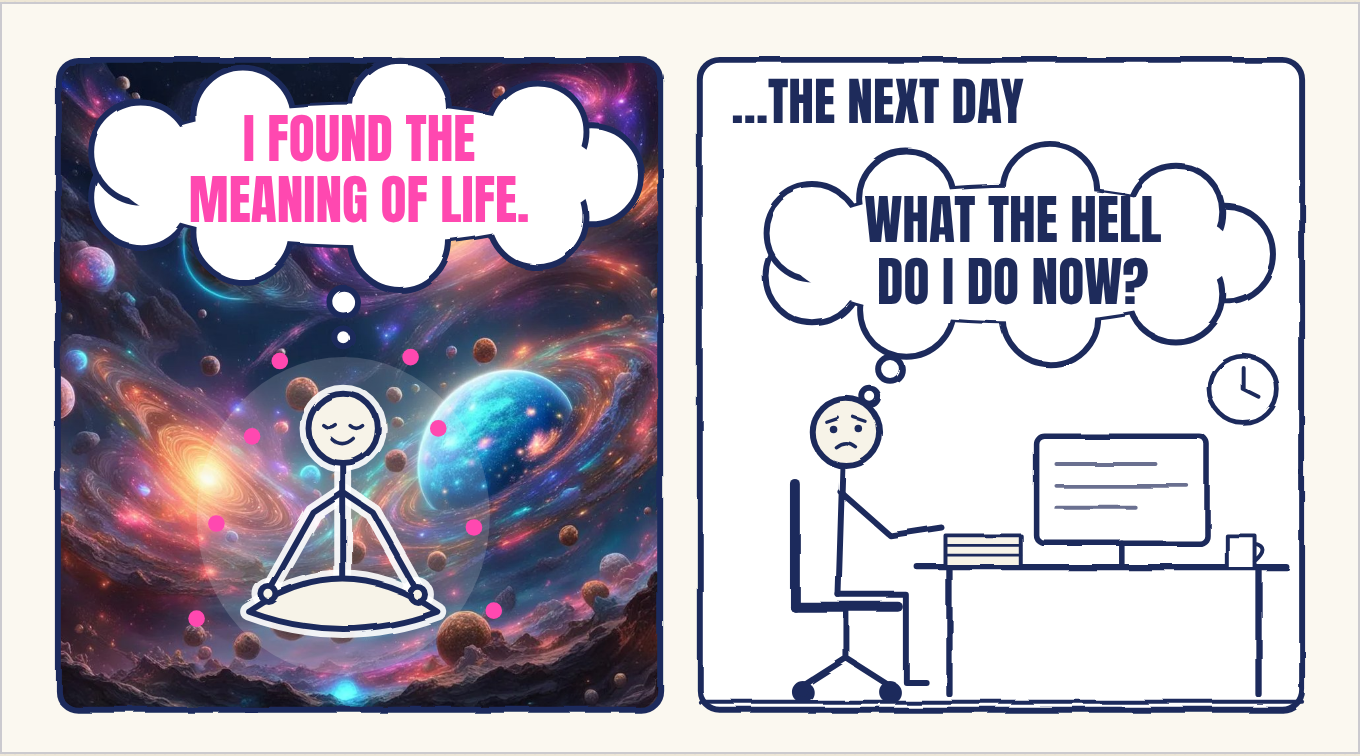
Over the next 10 to 20 years, more people will have mystical experiences than ever before, and most of them won’t know what to do with them.
These experiences can be launching pads into a deeper spiritual path, if someone catches people when they come back down. That means integration, a community, a teacher, a map, and people who’ve been there and can say, “Yeah, dude, that happened to me too; here’s what helped.” The point isn’t chasing the next state. It’s pointing people toward a deeper realization that stays. That’s a big part of what we want to help build.
So yes, this moment is absolutely an inflection point. But every one of these tools carries real risk, especially in irresponsible hands. There’s a deep, unsettling history of harm in the spiritual world, and it’s worth looking at why before we go any further.
Take Sogyal Rinpoche.
He wrote The Tibetan Book of Living and Dying, one of the best-selling Buddhist books ever published in the West, and built Rigpa, a network of centers on three continents. Thousands of students, many of them serious practitioners, were sure he was enlightened. Then in 2017, eight senior students wrote a letter describing decades of physical, sexual, and emotional abuse. An independent investigation by a UK law firm found most of it substantiated, along with a cover-up by the people around him (Lewis Silkin report, 2018; Tricycle). This is not an isolated case. You can find a version of this story in almost every lineage, in almost every era.
How in the world does this happen? How does someone who “woke up” use that same seeing to hurt people?
The simple answer is that you can still be a majorly flawed person after a spiritual awakening. A spiritual realization can land in whatever underdeveloped psychology is already there. If that psychology is immature, wounded, or power-hungry, the awakening gets read through that lens. At the small end, you get a teacher who abuses his students. At the large end, you get someone who decides his realization justifies wiping out everyone who doesn’t share his worldview.
In these cases, the damage doesn’t stop with the victims. Every time this happens, a huge number of people write off the whole “spiritual” project. “Look what that guy did after meditating for thirty years. No thank you.”
The deeper problem, as I see it, is that waking up is only one kind of growth, and most spiritual traditions treat it as the only kind worth chasing. They have a two-thousand-year-old technology for dissolving the “me” behind the forehead and not much for the rest of a person. Nothing on how to grow up. Nothing on cleaning up the wounds you carried in. Nothing on showing up in a world that has changed a lot since the texts were written.
Ken Wilber, the philosopher behind integral theory, has been saying this for decades, and his books are well worth your time. He separates four kinds of growth that together make a person whole (Finding Radical Wholeness). Waking up, the one we’ve been talking about, is just the first.
Here are the other three.
The other three
Growing up
Your circle of care gets bigger. First it’s just me. Then my people. Then all people. Then all of it, and every ring stays inside the next one.
Cleaning up
Upstairs, everything’s fine. Downstairs are the boxes you packed as a kid and never opened. Cleaning up is going down there with a flashlight.
Showing up
An ordinary Wednesday, done well. The insight only counts once it shows up in your calendar.
So the goal isn’t to wake up and stop. It’s to wake up and, at the same time, move along the other three lines.
Once you see these four as separate lines, a lot of the mess in the world starts to make sense. Most of it comes from people who are far along on one and nowhere on the others.
Woke up, didn’t clean up: the charismatic teacher who’s luminous on stage and cruel to the people closest to him. Grew up, didn’t wake up: the brilliant, ethical, well-therapized professional who’s still miserable because there’s a deep clinging to identity. Cleaned up, didn’t grow up: the person who’s done years of therapy and knows every one of their patterns, and still can’t take a perspective other than their own. Woke up and grew up, didn’t show up: the realized hermit whose insight dies with them.
We care about all four.
A world full of people who’ve glimpsed or stabilized non-separation but haven’t grown up or cleaned up isn’t the world I want. An embodied, integrated waking up is. That’s the bar for everything we cover.
It’s also why we don’t only cover meditation. Therapy, shadow work, developmental psychology, bodywork, community, and every piece of technology being built around all of it belong in the same conversation as the cushion and the ceremony. If it helps a person wake up, grow up, clean up, or show up, we want to understand it and explain it.
There’s a reason this can’t wait. It has to happen now.
We’re about to build the most powerful technology humans have ever made. And whatever we build will be, in some real way, a reflection of the same inner world we haven’t investigated. It’s trained on what we’ve written, shaped by what we reward, and pointed at what we want. Our flaws, insecurities, and anxieties don’t disappear when we hand them to a machine. They get amplified, at scale, faster than any person can notice.
Which makes this a strange moment to not know who we are. If we build superintelligence from inside the dream, we get tools that deepen the dream. If we build it awake, we might get tools that help end it.
The stakes are about as high as stakes get.
Why we need to accelerate inward
Technology keeps compounding. Personal development grew for a century, then leveled off.
Illustrative, not measured. Nobody tracks personal development well, which is sort of the point. Two real data points: computer chips went from 2,300 transistors (Intel 4004, 1971) to 208 billion (Nvidia Blackwell, 2024). Over roughly the same stretch, the share of Americans who call themselves “very happy” hovered around 30% for decades, then hit a record low of 19% in 2021 (General Social Survey).
The opportunity is just as big. AI could be the best translator of the wisdom traditions that has ever existed. Two thousand years of practice instructions, in dozens of languages, locked in texts most people will never read, could become a teacher that meets you where you are, in your language, for free.
And, as AI takes over more of what we currently call work, a lot of us are going to need a new answer to “what am I for?” that doesn’t come from a job.
Looking inward has never been more necessary than right now.
Accelerate Inward is a media company covering integrated spirituality (waking up, growing up, cleaning up, and showing up, all at once) and the technologies shaping it, such as meditation, psychedelics, neurotech, AI, therapy, and the science behind it all.
We’re a place to understand the inner world. We’re for the spiritually curious through to the deep practitioner. Anyone who wants to learn about the mind and is tired of choosing between credulous wellness content and science writing that puts you to sleep.
We’re also done dancing around the obvious.
A lot of people in psychedelics and in tech have to tiptoe around spirituality to stay credible. No such thing here! The wisdom traditions have a backbone, and we know where they lead, because we’ve walked some of the way ourselves. We don’t see science and spirituality as opposed. We see them explaining each other, more and more. We take both seriously in the same story: the first-person account (what it’s like from the inside) and the third-person account (what can be measured).
Transcend and include, as Wilber puts it.
Clear, honest writing on consciousness barely exists. Most coverage swings between breathless hype (“this mushroom cured my everything”) and lazy dismissal (“hippies are at it again”). The science press often doesn’t understand the practices. The spiritual press often doesn’t understand the science. Almost nobody is doing the slow work of explaining this field well, asking the hard questions, and being honest about what’s working and what isn’t as it grows.
Where the coverage sits
Oh, also, what’s up!
My name is Noah Edelman. I’m a young media entrepreneur in SF who loves writing, being outside, and getting far too competitive at board games. I found meditation in my childhood bedroom at 14, and I’ve been lucky to stumble into some incredible teachers and communities since, in everything from meditation to energy work to psychedelics to CBT. I’ve spent much of the last 18 months going deep into the world of meditation, yoga, and psychedelics, and learning how these practices can reach more people safely.
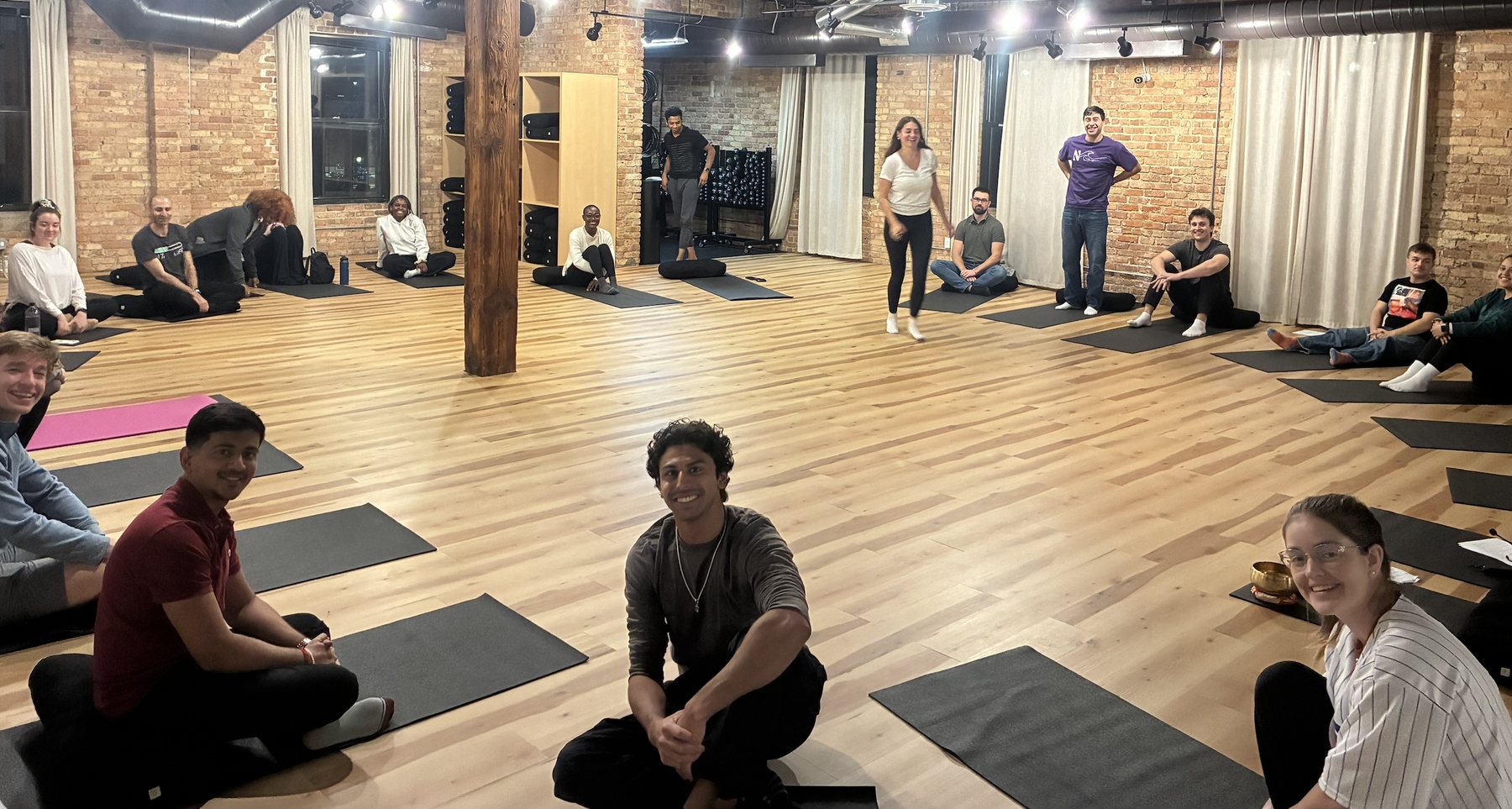
I’ve done a version of this before. In college, I co-founded The Neuron, a media company that explained AI to the public. In two years, we grew a daily newsletter to over 500,000 readers, got 100M+ views, and taught courses to more than 20,000 people.
Now I’m running the same playbook on something I care about even more.
I think we’re the right people to do this. We understand the technology and the trends as well as anyone covering them. But we also have our own practices. We sit, we go on retreat, we’ve done the medicine. We’re on this path ourselves, and we’re not going to hide that to look objective. I don’t think you should build these tools, or write about them, unless you’ve experienced them yourself and thought hard about the spiritual implications.
And let’s talk about money.
The spiritual world is usually allergic to money, and for good reason. Plenty of people have watched money turn teachers into brands, retreats into luxury goods, and the sacred into a product with a checkout page. (We’ve all seen the $10,000 “awakening intensive” and winced.) But I’ve come to believe our relationship to money matters more than whether we love it or hate it. We live inside a messy economic system, and pretending we don’t changes nothing. The useful question is how to use the system we actually live in to create the best outcome for the most people.
Money is a tool, and a powerful one. It’s what’s letting me start this company from the ground up. We’re self-funded to start, by me. We’re not raising money, and nobody is paying us to say any of this.
Also, you should know that we’re honest, but we’re not unbiased.
We want to see more of this stuff in the world. There’s a huge opportunity for technology and innovation to expose people to teachings and ways of life they’d never have run into otherwise, and we’re not going to sit on the sidelines for that. We want to contribute. We intend to help build this field, whether that means spinning out companies, nonprofits, or both. Whatever form it takes, we won’t pretend money or profit doesn’t exist.
That includes my own money. I’ve personally invested in a few companies in this field, and we’ll disclose those every time they come up. If there’s ever a conflict of interest, we’ll tell you. And if you think we missed one, please tell us.
If this company makes a lot of money, and so do the people building it, that’s great! We can reinvest in research, education, and community. The people who build this can go start their own companies, labs, and communities that help even more people.
That’s a flywheel very worth spinning, IMO.
The stakes are real.
Someone might try a practice, a substance, or a device because of something they read here. Someone in a hard place might trust what we wrote about a treatment, a teacher, or a retreat. Getting it wrong can hurt people. Getting it right can change a life.
So we’re making commitments from day one. We’ll fact-check. We’ll talk to skeptics as well as believers. Scientists will advise us on what’s real and what matters. We’ll take the harms as seriously as we celebrate the breakthroughs, including abuse in spiritual communities and bad actors in the psychedelic and wellness industries. And maybe most importantly, we’ll correct our mistakes in public.
What we won’t do is build products designed to be compulsive, sell protocols with promises the evidence can’t support, or turn awakening into a status symbol. If a sponsor or partner wants us to cross those lines, the answer is a hard no.
We’ll get some of this wrong. When we do, please hold us to these words.
Here’s what’s live or in motion, and where you fit in.

Essays, explainers, and profiles. I publish under the brand, we run guest posts, and we pay writers per story ($1,000 to $3,000). There are 23+ stories we want to fund right now, from covert consciousness to cessation. If you write, make video, or make shows about the mind, create with us.
Shows. We want to make shows with hosts who already live this stuff: live brain scans of deep meditators, long talks with people living in stable awakening, a neuroscientist and a monk mapping the same state, honest reviews of neurotech, and more. Pick one and host it, or bring your own. We help with production, design, distribution and growth.
Interviews and a podcast. Long conversations with the people doing the work. Follow along on X, YouTube, and Substack.
A library, a theory tracker, and a research page. The maps of the path in the library, the live theories of consciousness, and the latest research, kept current, in one place.
Paying for it. One partner backs the first season of stories, with their name on every piece. See the package.
And two things anyone can do. Read this, send it to one person who should be thinking about it and isn’t, then sign up at accelerateinward.com.
We are sleeping.It’s time to wake up.
Push back, add what we missed, or tell us what landed. The discussion lives on Substack.
Four doors in. Pick the one that fits.
Pitch one of 23 stories we want to fund ($1,000 to $3,000), send a guest post, or host one of our shows.
Start here 02Scientists and practitioners who keep every piece rigorous. Credited on the masthead.
Apply to advise 03One partner funds the first season of long-form stories. Your name on every piece.
See the package 04Disagree with any of this? We want to hear it, and we’ll publish the best replies.
Write to Noah